
It was a Tuesday afternoon, and my six-year-old son, let’s call him Evan, was having what I can only describe as a full-body meltdown over… a banana. Yes, you read that right. A banana that had dared to have a brown spot on it. He was screaming, crying, throwing himself on the kitchen floor like the world was ending.
I stood there, exhausted, holding the offending fruit, thinking: This isn’t really about the banana, is it?
That’s when it hit me. Evan didn’t have the words for what he was feeling. The frustration from a tough day at school, the disappointment that his best friend didn’t sit with him at lunch, the exhaustion from growing up—it was all bottled up inside, and that banana was just the cork popping off.
Sound familiar, mama?
Our kids experience the same complex emotions we do—anger, sadness, jealousy, anxiety, joy, fear—but they lack the vocabulary and the tools to name them, understand them, and work through them in healthy ways. They can’t exactly say, “Mom, I’m feeling overwhelmed by social dynamics at school and I need some emotional regulation strategies.” Instead, we get the banana meltdown.
That’s where books come in. And not just any books—the right books. Books that put feelings into words, that show characters navigating the emotional roller coaster of childhood, that give our kids a framework for understanding the storm inside them.
After that banana incident, I went on a mission. I talked to teachers, librarians, child psychologists, and other moms. I read review after review. And most importantly, I sat with Evan night after night, working through a carefully curated collection of books that became our emotional toolkit.
Today, I’m sharing those twelve must-have books with you. These aren’t just stories—they’re conversation starters, teaching moments, and gentle guides that help our kids process big emotions in developable, age-appropriate ways. Think of them as the literary equivalent of a warm hug and a wise talk, all wrapped into one.
Why Books Are Emotional Superpowers for Kids

Before we dive into the list, let’s talk about the “why” for just a moment.
Reading about emotions in a safe, story-based context allows kids to:
Identify and name their feelings. When a character in a book feels angry, sad, or scared, your child learns to recognize those same feelings in themselves.
See healthy coping strategies in action. Books model problem-solving and emotional regulation in ways that feel natural and non-preachy.
Feel less alone. Knowing that other kids (even fictional ones) feel the same way is incredibly validating and comforting.
Build empathy. Understanding characters’ emotions helps kids understand the feelings of real people around them.
Open up conversation. A book gives you a neutral third party to discuss. Instead of “Why did you hit your sister?” it becomes “How do you think that character felt when…?”
Now, let’s get to those twelve game-changing books.
The Ultimate Emotional Library: 12 Books Every Parent Needs
1. “The Color Monster” by Anna Llenas
Best for: Ages 3-6 | Understanding and organizing emotions
This book is pure magic for little ones just beginning to understand their feelings. The Color Monster wakes up confused because all his emotions are tangled up. With the help of a little girl, he learns to separate and identify each emotion by color: yellow for happiness, blue for sadness, red for anger, black for fear, and green for calm.
Why it works: The visual representation of emotions as colors is brilliant. After reading this with Evan, we started using color language. “Are you feeling red right now?” became an easy, non-confrontational way to check in.
Mama tip: Get some colored jars or containers and let your child draw or write about their feelings, then “organize” them like the Color Monster does. It’s a fantastic hands-on activity that extends the learning.
2. “In My Heart: A Book of Feelings” by Jo Witek
Best for: Ages 2-5 | Identifying a range of emotions
This beautifully illustrated board book uses die-cut hearts to explore different feelings. Each page shows what a specific emotion feels like “in my heart”—brave feels like standing tall, sad feels like a rainy day inside.
Why it works: The simple, poetic language and tactile element (the cut-out heart on each page) make abstract emotions concrete for toddlers and preschoolers.
Personal insight: This was Evan’s first “feelings book,” and he carried it around for months. The physical act of touching the heart on each page seemed to help him connect with the emotion being described.
Our E-book


3. “When Sophie Gets Angry—Really, Really Angry…” by Molly Bang
Best for: Ages 4-8 | Processing anger and finding calm
Sophie gets angry when her sister takes her toy. She gets SO angry that she feels like she might explode. The book follows her as she runs outside, cries, climbs a tree, and eventually calms down.
Why it works: It validates anger as a normal emotion and shows a healthy way to work through it—taking space, moving your body, and allowing time to cool down.
Conversation starter: After reading, ask: “What does Sophie do to feel better? What helps you when you feel really, really angry?” This opens up a dialogue about your child’s own calming strategies.
4. “The Invisible String” by Patrice Karst
Best for: Ages 4-8 | Separation anxiety and connection
This touching story introduces the concept of an “invisible string” that connects people who love each other, no matter how far apart they are. It’s particularly helpful for kids struggling with separation anxiety, divorce, or loss.
Why it works: It gives kids a tangible metaphor for an intangible feeling—the lasting connection of love.
Mama memory: I read this to Evan before his first overnight at Grandma’s house. We talked about our invisible string, and he went to bed that night with so much more confidence. Now, whenever he’s nervous about being apart, we give our string a little “tug.”
5. “The Rabbit Listened” by Cori Doerrfeld
Best for: Ages 3-7 | Grief, sadness, and the power of presence
After Taylor’s block tower falls down, various animals offer different advice—”talk about it,” “get angry,” “build a new one.” But only the rabbit simply sits and listens. Eventually, Taylor finds their own way to process the loss.
Why it works: This book teaches a profound lesson about empathy—that sometimes what we need most isn’t advice or solutions, but someone who will just be with us in our sadness.
For you, mama: This book also taught me something. I’m a fixer. When Evan is upset, my instinct is to jump in with solutions. This book reminded me that sometimes, I just need to be his rabbit.
6. “A Little Spot of Feelings” Series by Diane Alber
Best for: Ages 4-8 | Multiple books for specific emotions
This series includes individual books for anger, anxiety, sadness, confidence, and more. Each “spot” is personified as a colorful character that grows or shrinks based on how the child manages it.
Why it works: The series approach lets you target specific emotions your child is struggling with. The “spots” give kids a way to visualize and externalize their feelings.
Strategic reading: We keep the whole set on a low shelf. When Evan is struggling, I let him pick which “spot” book he needs that day. It gives him agency in his emotional processing.
7. “My Many Colored Days” by Dr. Seuss
Best for: Ages 3-6 | Mood variations and emotional fluidity
In classic Seuss style, this book uses colors and animals to describe different emotional states. “On Bright Blue Days, how I love to feel like a horse and to say: Hurray!”
Why it works: It normalizes the fact that our moods change, and that’s okay. We don’t feel the same way all the time, and different feelings call for different responses.
Daily check-in: We use this book as inspiration for a morning ritual. “What color day is it for you today?” It’s a quick, fun way to gauge Evan’s emotional state before school.
8. “The Way I Feel” by Janan Cain
Best for: Ages 3-7 | Vocabulary building for emotions
This vibrant book introduces a wide range of emotions beyond just happy, sad, and angry—silly, frustrated, jealous, proud, and more. Each emotion is paired with a scenario kids can relate to.
Why it works: It expands your child’s emotional vocabulary, which is crucial. When kids can name what they’re feeling, they’re better equipped to manage it.
Word expansion: After reading, we play “feelings charades.” Evan acts out an emotion and I guess it, then we switch. It’s educational and hilarious.
9. “Alexander and the Terrible, Horrible, No Good, Very Bad Day” by Judith Viorst
Best for: Ages 4-8 | Bad days and resilience
Alexander has one of those days where absolutely everything goes wrong. The book doesn’t offer a magical solution—it just validates that sometimes, days are just hard.
Why it works: It’s deeply validating. Kids need to know that bad days happen to everyone, and that it’s okay to feel frustrated, sad, or overwhelmed.
Real talk: We have a rule in our house now. If someone is having “an Alexander day,” we all give them a little extra grace. It’s become our family shorthand for “I’m struggling and I need you to understand.”
10. “Visiting Feelings” by Lauren J. Rubenstein
Best for: Ages 4-9 | Mindfulness and emotional awareness
This book introduces mindfulness concepts, teaching kids that feelings are like visitors—they come and they go. It encourages children to notice where they feel emotions in their bodies.
Why it works: The body-based approach is powerful. Many kids (and adults!) don’t realize that anxiety might show up as a tight tummy, or anger as hot cheeks.
Practice together: After reading, we do “body scans.” I ask Evan to close his eyes and notice: “Where do you feel happy in your body? Where do you feel worried?” It’s amazing how this simple practice has increased his self-awareness.
11. “The Feelings Book” by Todd Parr
Best for: Ages 2-6 | Normalizing all emotions
With his signature bright, bold illustrations, Todd Parr covers a huge range of feelings with simple, affirming statements: “Sometimes I feel silly,” “Sometimes I feel scared,” “Sometimes I feel like celebrating.”
Why it works: The inclusive, non-judgmental tone makes every feeling feel okay and normal. There’s no “good” or “bad” emotions—just feelings.
For younger siblings: This is perfect for toddlers and preschoolers. The simple text and colorful pictures hold their attention, and it’s a gentle introduction to emotional literacy.
12. “What to Do When You Worry Too Much: A Kid’s Guide to Overcoming Anxiety” by Dawn Huebner
Best for: Ages 6-12 | Anxiety and worry management
This is part of the “What to Do” series and is more interactive. It uses cognitive-behavioral techniques to help kids understand and manage anxious thoughts. It includes exercises and activities.
Why it works: It’s not just a story—it’s a workbook that gives kids concrete strategies. It teaches them to “talk back” to their worries and shrink their “worry brain.”
When to use it: If your child struggles with persistent worry or anxiety (especially at bedtime or before school), this book is a gentle, non-clinical way to introduce coping skills. Much like how you might mark special moments with something permanent and meaningful—similar to the bond celebrated in <a href=”https://doparenting.com/7-mother-daughter-tattoos-ideas/” target=”_blank”>mother daughter tattoos</a>—this book creates a lasting framework your child can return to again and again.
Professional backup: We used this book in conjunction with recommendations from Evan’s school counselor. It complemented his sessions beautifully and gave us a common language at home.
How to Make the Most of These Books (Because Just Reading Isn’t Enough)
Alright, mama, you’ve got your book list. But here’s the secret sauce: how you read these books matters just as much as which books you read. These aren’t bedtime stories to rush through before lights-out (though they can be part of that routine). They’re tools, and like any tool, they work best when used intentionally.
Create a Cozy Reading Ritual
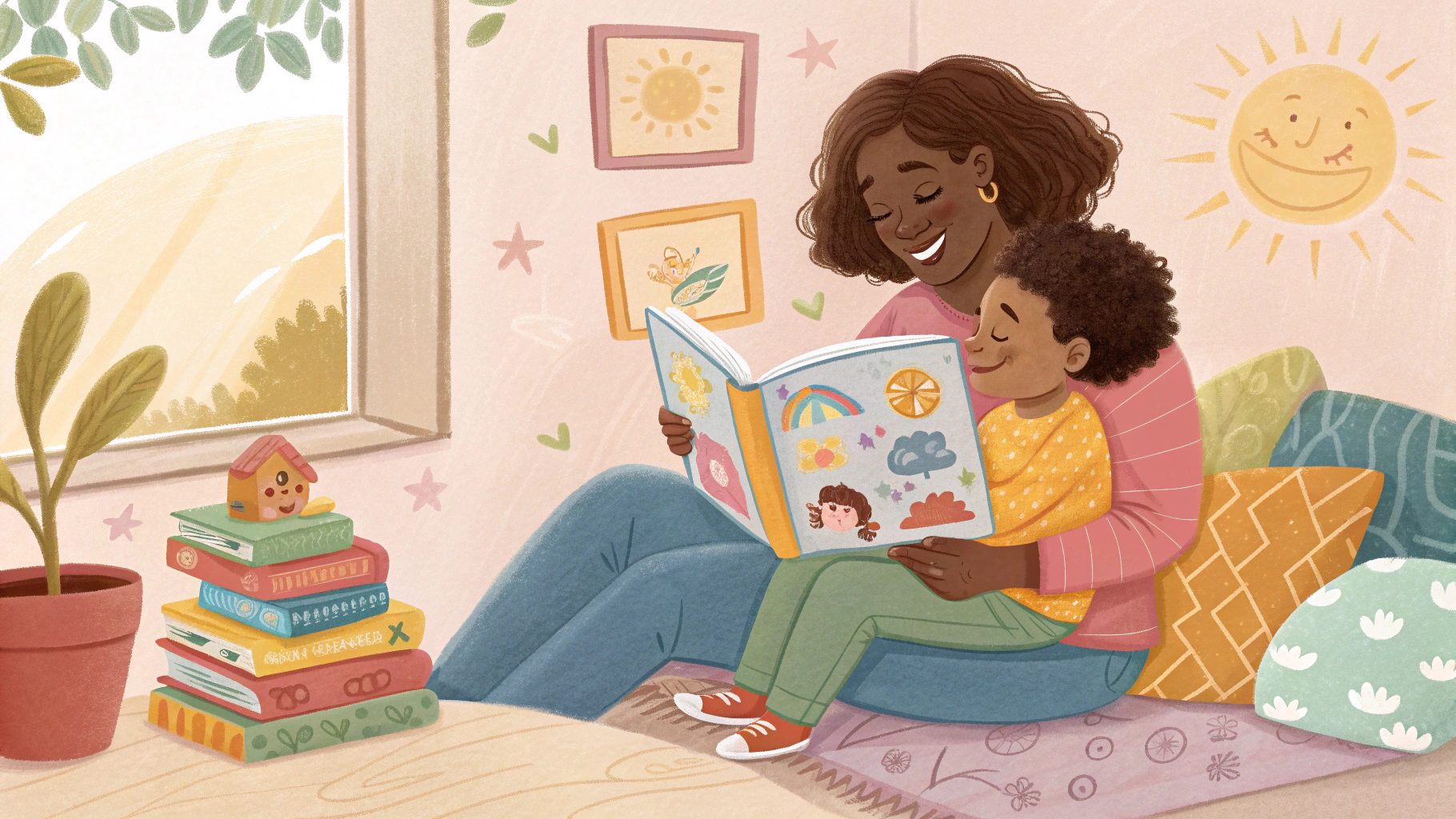
Make emotional reading time special. We have a “feelings corner” in Evan’s room with pillows, a soft blanket, and a basket of these books. When it’s time to talk about emotions, we go there. It signals to him that this is a safe, comfortable space for big conversations.
Read Slowly and Pause Often
Don’t just read the words—pause on each page. Ask questions: “How do you think they feel right now?” “Have you ever felt like that?” “What do you notice in the picture?”
Validate, Validate, Validate
If your child says, “I feel like that when Daddy goes to work,” don’t minimize it with “Oh, Daddy always comes back!” Instead, try: “I hear you. It feels sad when Daddy leaves, doesn’t it? That invisible string connects you two, even when he’s at work.”
Model Your Own Emotions
Share age-appropriate examples of your own feelings. “You know what? Mommy felt really frustrated today when the car wouldn’t start. I felt red, like the Color Monster. So I took some deep breaths, just like we read about.”
Revisit Books During Calm Moments
Don’t wait for a meltdown to pull out these books. Read them regularly during calm times so the lessons sink in and your child can reference them when they are struggling.
Extend the Learning
Use the concepts from the books in daily life. “I see you clenching your fists. Are you feeling angry? What does Sophie do when she feels really, really angry?” This reinforcement is key.
The Real-Life Impact: Our Journey Six Months Later
I won’t lie and tell you that these books magically eliminated all emotional struggles in our house. Evan still has hard days. We still have banana-level meltdowns (though now they’re more about screen time limits than fruit). But here’s what has changed:
He has words now. Instead of just screaming or hitting, he can say, “I’m feeling red” or “My worry brain is big today.” That shift from reaction to communication is monumental.
He’s more aware of his emotions before they explode. He’ll tell me, “I need to go to my room for a minute,” and he’ll sit with his feelings books or do some of the exercises from the anxiety workbook.
We have connection instead of conflict. These books gave us a shared language and understanding. Emotional conversations don’t feel like discipline—they feel like teamwork.
His empathy has grown. He notices when his little sister is sad and will bring her “The Rabbit Listened” and sit with her. Be still, my heart.
Your Emotional Toolkit Starts Now
Mama, the truth is that raising emotionally intelligent kids isn’t about never having hard moments. It’s about giving them the tools to navigate those moments with awareness, compassion, and resilience.
These twelve books aren’t just pages and pictures—they’re bridges to understanding. They’re whispered reassurances that feelings are okay. They’re roadmaps through the sometimes scary terrain of childhood emotions. They’re conversation starters that can transform your relationship with your child.
So, pick one or two that resonate with you and your child’s current struggles. Add them to your cart, check them out from the library, or order them tonight. Read them together, talk about them, and watch as your child begins to build their emotional vocabulary and coping skills, one page at a time.
Start building your family’s emotional library today, and remember: every big feeling your child learns to name and navigate is a step toward raising a confident, empathetic, emotionally healthy human. And that, dear mama, is the most important work we do.
“Children are not things to be molded, but people to be unfolded.” — Jess Lair
What’s one emotion your child struggles with most? Pick the book that addresses it and start there. Trust me, those small bedtime reading moments will become the foundation for a lifetime of emotional intelligence. You’ve got this.
